Email marketing is still one of the highest-ROI channels for small businesses.
Yet most emails never get opened, never get read, and never get a response.
The reason is simple:
Most emails are written for the sender, not the reader.
In 2026, attention is limited, inboxes are crowded, and customers decide in seconds whether an email is worth their time. Businesses that understand this shift are seeing better engagement without sending more emails.
The goal is no longer to send more messages.
It’s to send clearer, more useful ones.
The fastest way to lose a reader is to overload them.
Many business emails try to:
All at once.
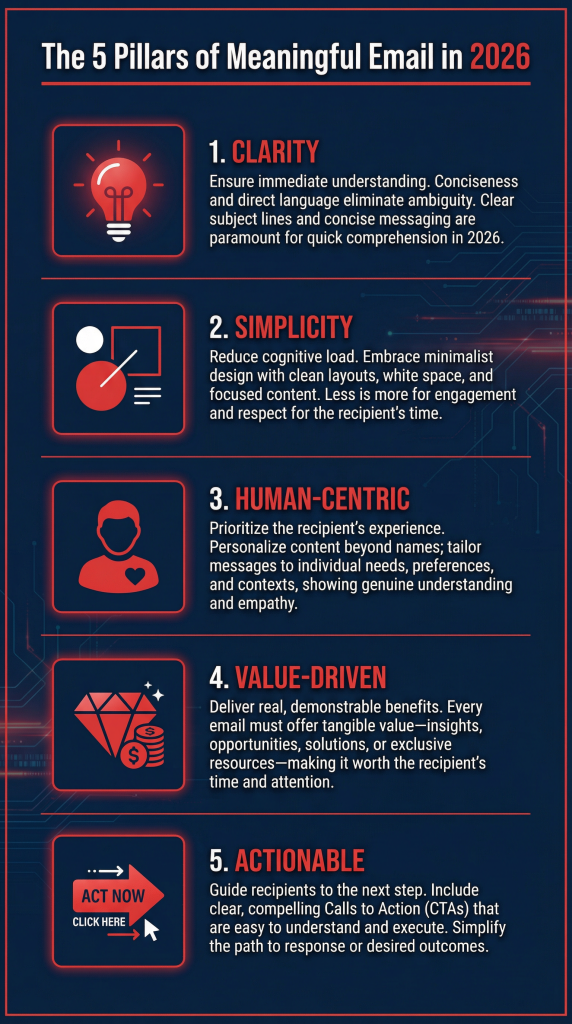
Emails that perform well do one thing only.
Before writing, ask:
What is the single action or takeaway this email should create?
One message.
One purpose.
One clear next step.
Clarity increases open rates, reading time, and responses, especially for small business email marketing.
If the subject line doesn’t create relevance, the email doesn’t get opened.
In 2026, subject lines that work are:
Weak subject lines:
Stronger subject lines:
Your subject line sets expectations.
The email must deliver on that promise, otherwise trust erodes.
People skim emails before they read them.
That’s why high-performing emails use BLUF (Bottom Line Up Front):
Instead of opening with small talk or long introductions, get to the point quickly. Respecting attention is now a core part of digital communication strategy.
Most people read emails on their phones, between tasks.
That means:
Long blocks of text increase friction and reduce engagement.
Good email formatting isn’t design fluff, it directly affects how much of your message gets read.
Many emails fail because they start from the wrong perspective.
They begin with:
But readers are silently asking:
Why does this matter to me?
Emails people want to read start with the reader’s problem, question, or goal, then connect it to your message.
This shift alone can significantly improve customer engagement.
Many emails fail because they start from the wrong perspective.
They begin with:
But readers are silently asking:
Why does this matter to me?
Emails people want to read start with the reader’s problem, question, or goal, then connect it to your message.
This shift alone can significantly improve customer engagement.
If every email asks for something, people stop opening them.
High-trust businesses use email to:
Even when an email doesn’t lead to an immediate action, delivering value builds long-term engagement and improves future open rates.
Multiple CTAs create hesitation.
Effective emails guide readers toward one simple action, such as:
Clear CTAs reduce decision fatigue and increase response rates.
In 2026, readers can instantly detect emails that sound templated or over-automated.
Strong business emails:
AI can help with drafts, but the final message should sound like you, not software.
This matters more than ever for small businesses competing on trust and relationships.