
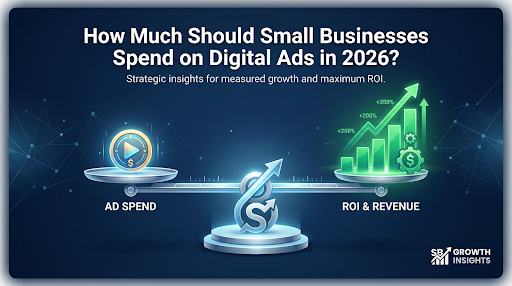
“How much should we spend on digital ads?”
It’s one of the most common and most misunderstood questions small business owners ask.
Some businesses spend too little and see no results.
Others spend aggressively and still feel like money disappears without returns.
The issue is rarely the number itself.
The issue is what sits behind the spend.
In 2026, digital ads don’t create growth on their own.
They amplify whatever system your business already has.
Many small businesses believe:
“If ads don’t work, we need to spend more.”
In reality, increasing ad spend usually magnifies the real problem:
Ads don’t fix these issues, they expose them faster.
That’s why two businesses can spend the same amount and see completely different outcomes.
Before setting any ad budget, ask one critical question:
Can your website convert attention into action?
If visitors land on your site and:
Then ads will drive traffic, not results.
In 2026, website clarity, speed, and conversion structure matter more than ad creatives alone.
For many small businesses, a healthy starting range is:
5–10% of monthly revenue
But this only works when:
If these aren’t in place, starting with smaller test budgets is far smarter than committing to higher spend too early.
This is where bad chatbots fail the most.
Helpful AI lets users:
Creepy AI traps users, loops them, or forces specific actions.
Nothing hurts conversions faster.
Not all small businesses should approach digital ads the same way.
Ad spend should evolve with the business, not stay fixed
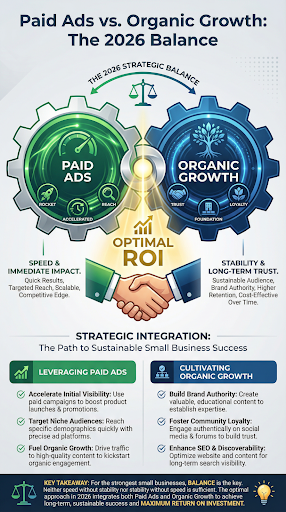
Paid ads deliver speed.
Organic marketing delivers stability.
The strongest digital strategies in 2026 combine:
This combination reduces cost per lead and improves overall ROI.
Choosing one over the other limits growth.
When campaigns underperform, the instinct is often:
“Let’s increase the budget.”
But performance issues usually come from:
Fixing these almost always improves results without increasing spend.
This is why smart digital marketing focuses on systems first, spend second.
Digital ads are no longer shortcuts.
They are multipliers.
If your digital foundation is strong, ads accelerate growth.
If it’s weak, ads make the gaps obvious.
That’s why the smartest small businesses don’t obsess over how much they spend, they focus on whether they’re ready to scale.
There’s no universal “right” ad budget.
But there is a smart approach:
When done correctly, digital ad spend stops feeling like a gamble and starts behaving like an investment.