
Email marketing still works in 2026.
But attention is fragile.
Customers don’t unsubscribe because businesses send emails.
They unsubscribe because emails feel irrelevant, repetitive, or poorly timed.
That’s why asking how often to send marketing emails misses the bigger issue.
The real question is:
How often can you show up in the inbox without breaking trust?
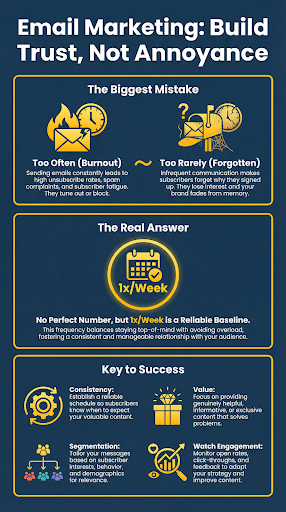
Most small businesses fall into one of these traps:
Sending frequent promotions with little value, hoping something sticks.
Result:
Sending emails so rarely that customers forget who you are.
Result:
Neither approach works long term.
There’s no universal rule that fits every business.
However, for most small businesses in 2026, one email per week is a strong starting point.
Why weekly works:
Frequency works when it’s paired with relevance.
Customers don’t get annoyed by emails that arrive regularly.
They get annoyed by emails that arrive randomly or without purpose.
A consistent schedule creates expectation:
“This is their weekly email.”
Random bursts create friction:
“Why am I hearing from them now?”
Consistency builds familiarity.
Familiarity builds trust.
Before worrying about how often you email, ask:
Would I open this myself?
Emails that perform well usually:
Purely promotional emails sent repeatedly are what cause fatigue, not frequency itself.
Another reason emails feel annoying is irrelevance.
Sending the same message to everyone increases fatigue.
Even basic segmentation helps:
Segmentation makes emails feel personal, which allows you to email intentionally without emailing more often.
Instead of following rigid rules, pay attention to real signals:
If engagement drops:
What you shouldn’t do is disappear completely.
Silence often hurts trust more than thoughtful consistency.
Email marketing isn’t just a channel.
It’s a relationship.
Every email either:
That’s why restraint matters as much as presence.
If your email:
you’re unlikely to annoy customers, even at weekly frequency.
If it exists only to push, no frequency will fix it.
The goal of email marketing isn’t to send more emails.
It’s to remain welcome in the inbox.
For most small businesses, that means:
That’s how email marketing continues to work, even in crowded inboxes.