

Is Your Website a Brochure or a Salesperson? The 2026 Perspective on Small Business Websites

Website a Brochure

In 2026, customer behavior has changed faster than most small businesses realize.

People don’t browse websites for fun, they’re trying to solve a problem quickly.

And that exposes a painful truth:

Most small business websites still behave like digital brochures.
They look nice, share information, and quietly hope the visitor figures out what to do.

The problem?
A brochure website doesn’t sell, guide, qualify, or convert. Which means it doesn’t drive revenue.

But the businesses winning in 2026 all have one thing in common:
their website behaves like a salesperson, not a brochure.

Here’s what that means.

A Brochure Website Only Shares Information

These websites usually have:

  • Generic homepage copy
  • Vague service Descriptions
  • No clear call-to-action
  • Cluttered navigation
  • Long paragraphs Visitors skip
  • Design over function

It looks good, but it doesn’t work.

A brochure website assumes the visitor knows what to do next.
They don’t.
They leave.

A Sales Website Guides, Educates, and Converts

A high-performing website behaves like a trained salesperson:

  • It guides the visitor step by step
  • Answers objections clearly
  • Shows credibility upfront
  • Explains value simply
  • Tells users exactly what the next step is
  • Captures leads at the right moments
  • Qualifies interest automatically

The result?
Higher conversions with the same traffic.

In 2026, Google now prioritizes websites that deliver clear, fast, helpful experiences, all qualities found in a “sales website,” not a brochure.

Website Performance Is Now Directly Tied to Sales

In 2026, a slow, confusing website destroys sales.
Google and customers both punish bad experiences.

Google measures:

  • Page load time
  • Clarity
  • Mobile responsiveness
  • Time on page
  • User journey friction

If your website loads slowly or leaves users confused, you lose ranking and revenue.

A Sales Website Works 24/7, Without Staff

Imagine a salesperson that:

  • Never sleeps
  • Never misses a message
  • Qualifies leads automatically
  • Follows up instantly
  • Explains pricing clearly
  • Books appointments on its own

That’s what a modern 2026 website can do when it’s built properly.

Your website should reduce human workload, not add to it.

Content Must Support Decision-Making, Not Just Look Nice

In 2026, your website must answer:

  • Who is this for?
  • Why should I trust you?
  • What makes you different?
  • What is the next step?

Helpful content converts.
Aesthetic content distracts.
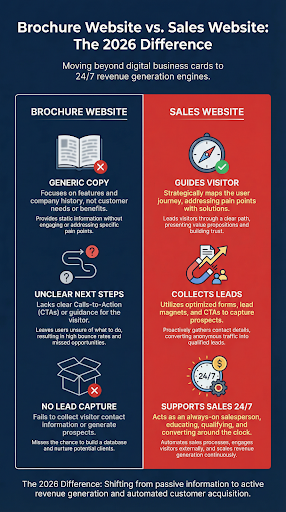
 

Infographic comparing the outdated brochure website model with the modern, red-highlighted sales website model for 2026

The 2026 Rule:

A brochure website costs money.
A sales website makes money.

Most small businesses don’t need more traffic, they need a website that can convert the traffic they already have.

Your website is either a liability…
or your hardest-working digital employee.

If you want your website to act like a real digital asset, not a static brochure, Radial North builds conversion-driven websites designed to sell, qualify, and support your business 24/7.

FAQs

What’s the difference between a brochure website and a sales website in 2026?

A brochure website displays information. A sales website guides the user, explains value, reduces friction, and converts visitors into leads.

Why do most small business websites fail to convert?

Because they focus on design instead of clarity, speed, messaging, and user intent, the elements that actually drive conversions in 2026.

How do I know if my website is costing me sales?

If users aren’t taking action, if the site loads slowly, or if you aren’t getting high-quality leads regularly, your website is functioning like a brochure.